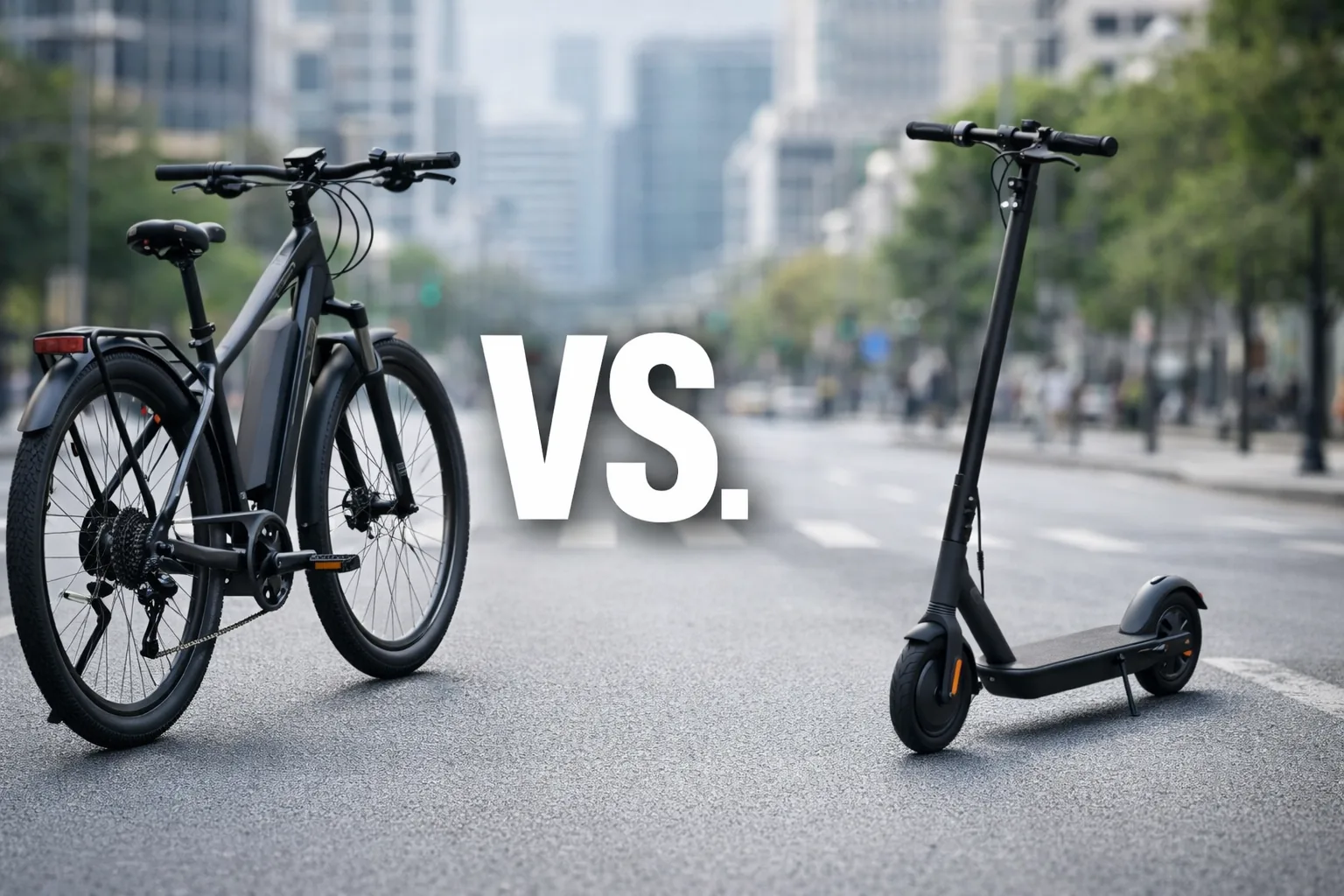
This is the question I hear most from first time buyers. They know they want an electric personal vehicle for urban commuting, but they are not sure which form factor fits their life. Both fall under the growing micromobility category. Having sold and serviced both for years, I can tell you that neither is universally better. The right choice depends entirely on how you plan to use it.
The Quick Answer
Choose an e-bike if you ride more than five miles, want exercise built into your commute, need to carry cargo, or ride in bad weather. Choose an e-scooter if you need something portable, have a short commute under three miles, and want the lowest possible upfront cost.
Speed Comparison
Most commuter e-bikes reach 20 to 28 mph depending on the class. E-scooters marketed for commuting typically cap out around 15 to 20 mph, though high performance models can hit 40 mph or more.
For practical urban commuting, both options are fast enough. The speed difference matters more on longer rides where an e-bike's higher sustained speed saves meaningful time. For a detailed speed breakdown, check our e-bike vs e-scooter speed comparison.
Range and Battery
E-bikes and e-scooters offer similar battery ranges of 15 to 40 miles per charge in most models. The critical difference is what happens when the battery dies.
On an e-bike, you keep pedaling. Your range is limited only by your legs. On an e-scooter, a dead battery leaves you with an awkward, heavy kick scooter. This backup ability makes e-bikes far more practical for longer or unpredictable commutes.
E-bikes also more commonly feature removable batteries. You can pop it off and charge it at your desk. Most e-scooters require you to bring the entire scooter to an outlet.
Portability and Storage
This is where e-scooters win clearly. A folding e-scooter weighs 20 to 40 pounds and folds down small enough to carry onto a bus or subway, store under a desk, or toss in a car trunk.
E-bikes weigh 40 to 75 pounds. You are not carrying one up stairs or bringing it into a coffee shop. They need a bike rack, a garage, or a secure outdoor lock up spot.
If your commute involves public transit, elevator rides, or tight apartment storage, an e-scooter removes a lot of headaches.
Comfort on Longer Rides
For anything over a couple of miles, e-bikes are significantly more comfortable. The seated position, larger wheels, and suspension options make a 10 mile ride feel easy. Standing on a scooter for 10 miles gets uncomfortable fast.
E-bikes also handle rough roads, potholes, and wet conditions much better. Larger wheels maintain better contact with the road, and full coverage fenders keep you dry.
Safety
E-bikes have real safety advantages. Larger wheels are more stable over bumps and debris. The riding position is higher and more visible to drivers. Braking is more controlled with larger disc brakes.
E-scooters have smaller wheels that are more vulnerable to potholes and cracks. A small pothole that a bike rolls over easily can send a scooter rider over the handlebars. Injury rates for e-scooters run two to three times higher than for bicycles according to public health data. For a deeper look at scooter drawbacks, we cover this in detail.
Exercise Factor
E-bikes let you choose your effort level. You can cruise on full assist for a sweat free ride, or dial it back and get a genuine workout. Studies show e-bike commuters still get meaningful cardiovascular exercise even with motor assistance.
E-scooters provide essentially zero exercise. For some riders, that is the whole point. They want to arrive clean and dry in work clothes without breaking a sweat.
Cost
| Category | E-Scooter | E-Bike |
|---|---|---|
| Entry level | $400 to $800 | $800 to $1,500 |
| Mid range | $800 to $1,500 | $1,500 to $3,000 |
| Premium | $1,500 to $3,000 | $3,000 to $6,000 |
| Maintenance (yearly) | $50 to $150 | $100 to $300 |
E-scooters cost less upfront and less to maintain. However, e-bikes tend to last longer and hold resale value better. For riders who use their vehicle daily, the e-bike often provides better long term value.
Environmental Impact
Both options are far greener than driving a car. An e-bike or e-scooter produces zero direct emissions and costs pennies per mile to charge. The environmental difference between the two is small. E-bikes have a slight edge because they last longer, meaning less frequent manufacturing waste. E-scooter tires and components wear out faster due to smaller wheels and the standing riding position.
Frequently Asked Questions
Which is better for a 5 mile commute?
An e-bike is the better choice for a 5 mile commute. The distance is long enough that the comfort of a seated position matters, and an e-bike handles hills and headwinds more effectively. An e-scooter can do 5 miles, but it is less comfortable at that distance.
Can I use an e-scooter in the rain?
Most e-scooters have some water resistance rated at IP54 or similar, meaning they can handle light rain. However, riding in wet conditions on small wheels is significantly more dangerous. Reduced traction and visibility make rain riding risky on a scooter.
Which is easier to maintain?
E-scooters have fewer moving parts, but when something breaks, repairs can be harder to find locally. E-bikes use standard bicycle components that any bike shop can service. For long term maintenance ease, e-bikes have the advantage.
Are e-scooters legal everywhere?
No. E-scooter laws vary widely by city and state. Some cities ban them from sidewalks, others require helmets, and a few have banned them entirely. Check your local regulations before buying.
Can I carry groceries on an e-scooter?
Very limited. Most e-scooters have no cargo capacity beyond a small backpack. Some models accept handlebar bags, but carrying more than a few pounds affects balance. E-bikes can use front and rear racks, panniers, and baskets for serious cargo capacity.