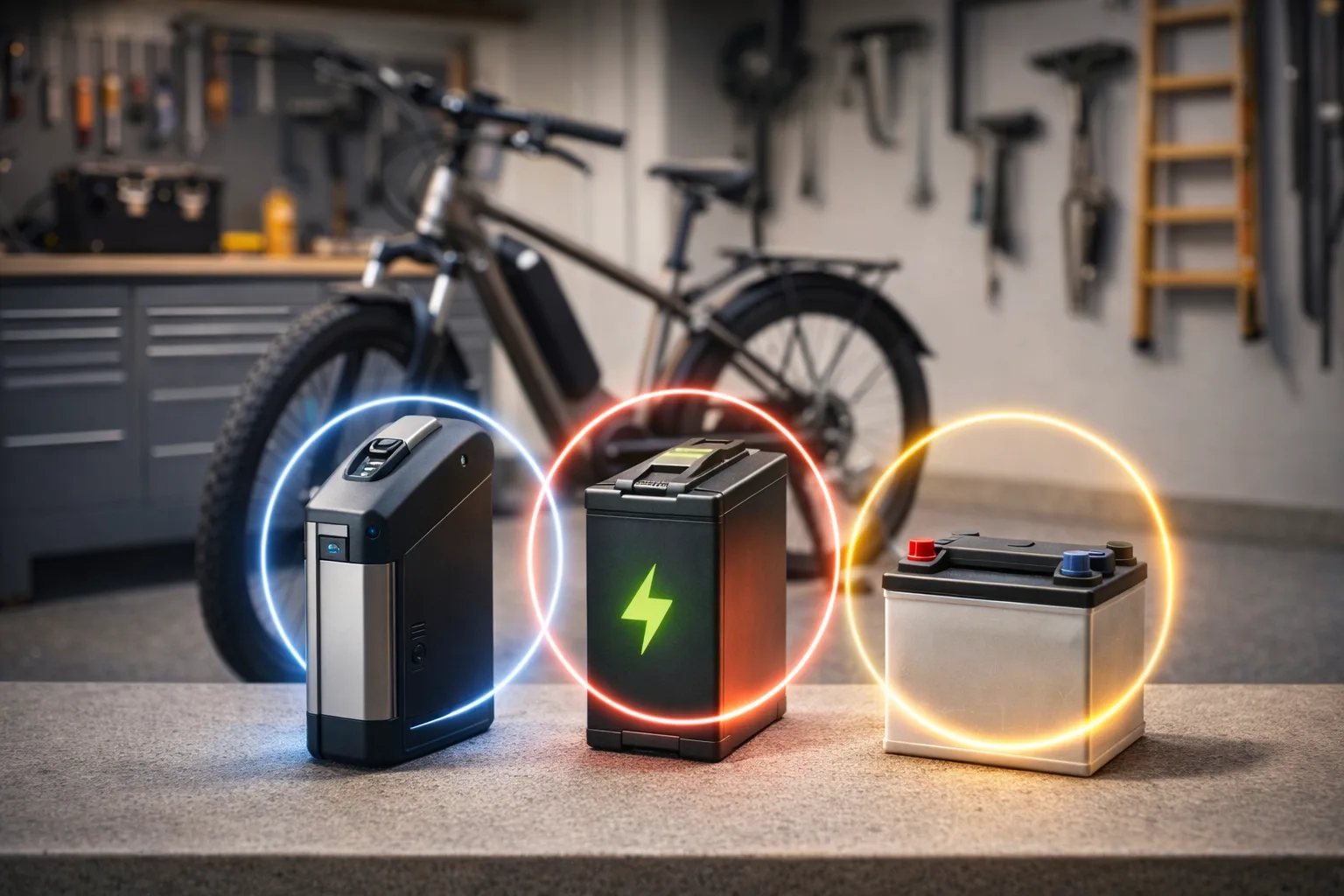
Not all e-bike batteries are created equal. The type of battery inside your electric bike affects everything from how far you can ride to how long the battery lasts before it needs replacing. There are three main options on the market right now, and each one has clear strengths and trade offs.
I have worked with all three types in my shop. Here is an honest breakdown based on years of hands on experience.
Lithium Ion NMC (The Standard Choice)
NMC stands for nickel manganese cobalt. This is the most common battery type found in electric bikes today. If your e-bike was built in the last five years, it almost certainly has an NMC battery.
NMC batteries offer the best balance of weight, range, and performance. They pack energy densities between 150 and 250 watt hours per kilogram. That means they deliver solid range without making your bike feel like a tank.
A quality NMC battery lasts 800 to 1,000 full charge cycles. For a daily commuter riding 20 miles, that works out to about four to six years of use before noticeable degradation.
The downsides are cost and safety. NMC batteries are moderate to expensive, typically $400 to $900 for a replacement. They also carry a higher fire risk than other types if damaged or charged improperly.
Best for: Riders who want the lightest bike with the longest range. Mountain e-bike riders, road riders, and anyone who cares about keeping weight down.
LFP or LiFePO4 (The Safe and Affordable Choice)
LFP stands for lithium iron phosphate. These batteries have been gaining ground fast in the e-bike world, especially for commuters and cargo bike owners.
The biggest advantage of LFP is cycle life. These batteries can handle 2,000 to 5,000 full charge cycles. That is two to five times longer than a standard NMC battery. They are also significantly safer. LFP chemistry is far more thermally stable, which means the fire risk is dramatically lower.
The trade off is weight. LFP batteries weigh about 30 to 40 percent more than NMC batteries at the same capacity. For a commuter bike or a cargo hauler, the extra weight barely matters. For a lightweight trail bike, it can be a real drawback.
Price is another advantage. LFP batteries cost less per cycle of use, making them the best long term value. Upfront costs are comparable to NMC, but you get two to three times the lifespan.
Best for: Daily commuters, cargo bike riders, and anyone who prioritizes safety and long term value over weight savings.
Solid State (The Future)
Solid state batteries replace the liquid electrolyte found in conventional lithium ion batteries with a solid material. This change unlocks massive improvements across every performance metric.
Projected energy density ranges from 250 to 800 watt hours per kilogram. Cycle life could reach 10,000 charges or more. Fire risk drops dramatically because there is no flammable liquid inside.
The catch is that solid state batteries are not widely available for e-bikes yet. A few premium European brands are experimenting with limited releases in late 2025 and 2026, but prices are expected to be 40 to 60 percent higher than current lithium ion options. Toyota projects their first solid state vehicles will not arrive until 2027 or 2028.
Best for: Riders who can wait and have the budget for cutting edge technology. This will likely become the standard within five to ten years.
Side by Side Comparison
| Feature | NMC (Lithium Ion) | LFP (LiFePO4) | Solid State |
|---|---|---|---|
| Energy Density | High (150 to 250 Wh per kg) | Moderate | Very High (projected) |
| Cycle Life | 800 to 1,000 | 2,000 to 5,000 | 10,000 or more (projected) |
| Safety | Moderate | Excellent | Excellent (projected) |
| Weight | Lighter | 30 to 40 percent heavier | Lighter (projected) |
| Cost | $400 to $900 | Similar upfront, lower per cycle | Very high (not yet mainstream) |
| Availability | Everywhere | Growing fast | Limited |
My Recommendation
For most riders in 2026, NMC lithium ion remains the best overall choice. It is widely available, well understood, and offers the best power to weight ratio.
If you ride daily and want a battery that will outlast the bike itself, look seriously at LFP. The extra weight is worth the trade off for many commuters.
Keep an eye on solid state technology. When it becomes affordable and widely available, it will change everything about how far and how long we can ride.
Frequently Asked Questions
Can I switch from an NMC battery to an LFP battery on my existing bike?
In some cases yes, but it requires matching the voltage and ensuring the physical dimensions fit your bike's battery mount. LFP batteries at the same capacity are larger and heavier, so they may not fit in the same housing. Consult with an e-bike technician before making the swap.
Are LFP batteries really that much safer than lithium ion?
Yes. LFP chemistry is far more thermally stable. It has a much higher threshold for thermal runaway, which is the chain reaction that causes battery fires. This is why LFP is the preferred choice for indoor charging and storage.
When will solid state batteries be available for regular e-bikes?
Limited premium options are appearing in late 2025 and 2026 from select European manufacturers. Mainstream availability at reasonable prices is expected around 2027 to 2029. The technology works, but scaling production to bring costs down takes time.
Does battery type affect charging speed?
Somewhat. NMC batteries typically charge faster than LFP batteries of the same capacity. However, LFP batteries can safely handle faster charging rates without degradation. Solid state batteries are projected to support very rapid charging, potentially reaching 80 percent in under 15 minutes.
Which battery type is best for cold weather riding?
NMC batteries perform slightly better in cold temperatures than LFP. Both types lose range in cold weather, but LFP loses a bit more. If you ride in freezing conditions regularly, an NMC battery or a battery with a built in heating element is your best bet.