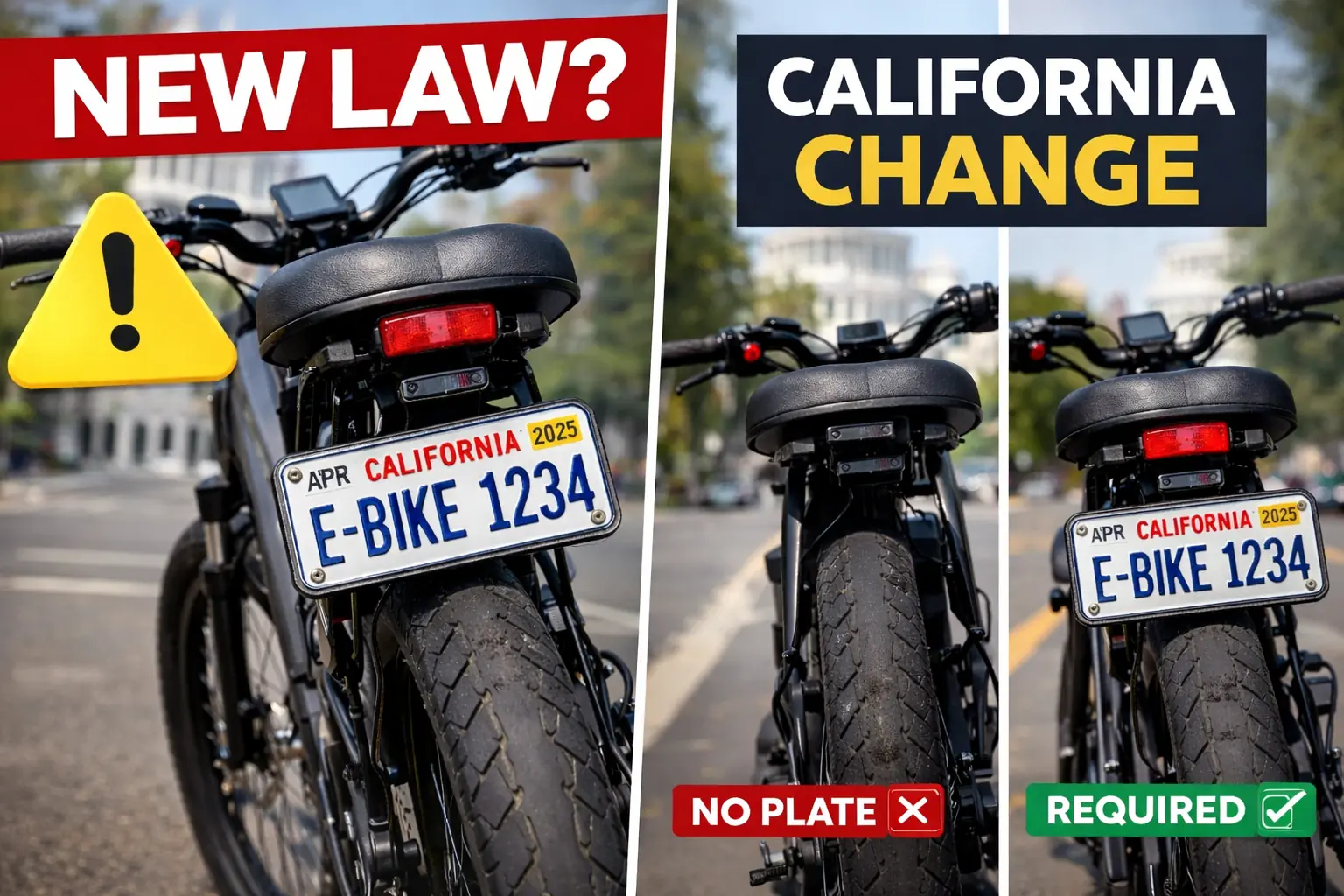
Imagine this. You ride your e-bike to work every morning. No traffic. No parking fees. No gas. Just you, two wheels, and the open bike lane.
Now imagine pulling up to the DMV to register that same bike. Waiting in line. Paying a fee. Bolting a metal license plate to the back of your ride.
That could become reality in California.
A New Bill Just Changed the Conversation
California Assemblymember Rebecca Bauer-Kahan just introduced Assembly Bill 1942. The name sounds boring. The impact is not. This bill, called the E-Bike Accountability Act, would require every Class 2 and Class 3 e-bike owner in California to register their bike with the DMV.
That means a license plate on the back of your e-bike. A real one. Issued by the state.
Right now, no state in America requires this. California would be the first.
Here Is What You Would Need to Do
If AB 1942 passes, you would need to visit the DMV, register your e-bike, and receive a special plate. You would also need to carry proof of ownership that matches your bike's serial number every time you ride.
No riding test. No written exam. Just paperwork, a fee, and a plate.
The registration cost has not been finalized, but early estimates put it between $50 and $200 per bike. The bill creates a new Electric Bicycle Registration Fund to collect that money.
Skip the registration? Police could fine you. They could also impound your bike on the spot.
Who This Affects
Not every e-bike owner would be hit. The bill only covers Class 2 e-bikes (throttle powered, up to 20 MPH) and Class 3 e-bikes (pedal assist, up to 28 MPH). Class 1 e-bikes are left out for now.
If you are under 18, you could still ride a Class 2, but your parents would handle the registration. Class 3 e-bikes stay completely off limits for minors.
Why California Says This Is Necessary
The reason behind the bill comes down to one word. Accountability.
E-bike injuries have been climbing across California. When something goes wrong on the road, there is no way to identify the rider. Cars have plates. Motorcycles have plates. E-bikes that hit 28 MPH have nothing.
Bauer-Kahan wants to change that. A plate on every e-bike means police can track riders involved in accidents, reckless riding, or hit and run incidents.
California already tightened e-bike rules this year. New laws now require UL safety certification on all replacement batteries. Rear lights became mandatory. Teen safety courses were added. This bill would be the next step.
Riders and Advocates Are Fired Up
Cycling groups are not taking this quietly. Bike East Bay called the bill counterproductive. Their argument is simple. The bill punishes the wrong people.
Most Class 2 and Class 3 riders are commuters, parents, and delivery workers who follow the rules. The real problem is illegal modified bikes and unregistered e-motos blasting past 40 MPH on sidewalks. This bill does nothing about those.
There is a bigger concern too. Adding DMV visits and fees to e-bike ownership could push people back into cars. That goes against everything California has been trying to do with its climate and traffic reduction goals.
What Happens Now
AB 1942 is still a proposal. It has not passed. Committee hearings and public comment come next. Both sides are gearing up for a fight.
But if you ride an e-bike in California, pay attention. This bill could change how you ride, what you carry, and what hangs off the back of your bike.
The days of riding free might be numbered.
Frequently Asked Questions
Does California currently require license plates for e-bikes?
No. As of February 2026, California does not require license plates or DMV registration for any class of electric bicycle. AB 1942 would change this for Class 2 and Class 3 e-bikes if it passes into law.
Which e-bikes would need license plates under this bill?
The bill targets Class 2 e-bikes (throttle capable, up to 20 MPH) and Class 3 e-bikes (pedal assist, up to 28 MPH). Class 1 e-bikes (pedal assist only, up to 20 MPH) are not included in the current version of the bill.
How much would e-bike registration cost in California?
The exact fee has not been finalized. Early estimates suggest it could cost between $50 and $200 per bike. The bill creates an Electric Bicycle Registration Fund to collect and manage the revenue. Final pricing will be determined as the bill moves through committee hearings.
Can police impound your e-bike if it has no license plate?
Under the proposed bill, yes. Police would have the authority to impound e-bikes that lack valid registration or a displayed license plate. Riders could also face fines for not carrying proof of ownership matching the bike's serial number.
Would you need to pass a test to register an e-bike?
No. The bill does not require any riding test or written exam. You visit the DMV, register the bike, pay the fee, and receive a plate. The process mirrors car registration without the driving test.