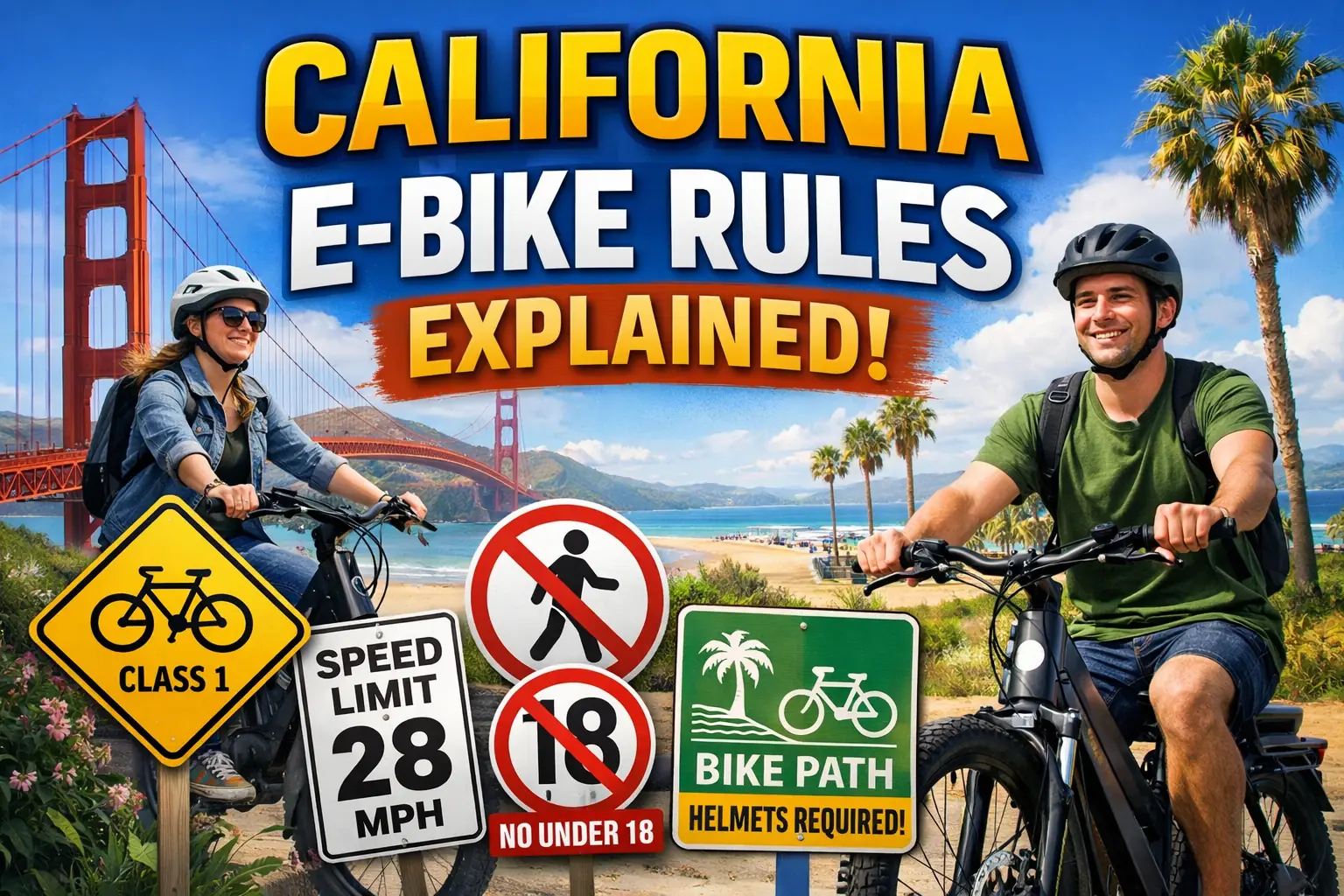
A 17-year-old on a throttle-equipped e-bike blew through a red light in Huntington Beach last summer. No helmet. No idea his bike was technically illegal. The $500 fine surprised him. The impound notice shocked his parents.
He's not alone. California overhauled its e-bike regulations in 2025 and 2026. Throttles banned on two out of three bike classes. Mandatory battery certifications. Local cities restricting who can even ride.
The Three Classes Got Sharper — and Your Bike May Have Switched
Senate Bill 1271, effective January 1, 2025, tightened California's three-class system in ways that reclassified thousands of bikes overnight.
Class 1 is pedal-assist only with no throttle, and the motor cuts out at 20 mph. Class 2 is now the only class that allows a throttle, capped at 20 mph. Class 3 provides pedal assist up to 28 mph with no throttle allowed, period.
Here's what catches riders off guard: California changed how motor power is measured. The old law focused on "continuous rated power," letting manufacturers game the numbers. The new law counts all power output, whether sustained or momentary. If your motor spikes above 750 watts for even a second, your e-bike might legally be a motor vehicle.
That's not a technicality. It's the difference between a bicycle and something that needs a license, registration, and insurance.
Age, Helmets, and the Rules That Change County to County
No statewide minimum age for Class 1 and Class 2. Class 3 requires riders to be at least 16. But local cities are rewriting the playbook. Marin County already restricts Class 2 to riders 16 and older and requires helmets for all ages. If you ride across county lines, the rules can change mid-ride.
For helmets: under 18 means a helmet on any e-bike, anywhere in California. Class 3 riders wear helmets regardless of age. Starting in 2026, minors need MIPS-certified helmets. Budget $50 to $80 for a compliant Bell or Giro.
Modifications Will Get Your Bike Impounded
Class 1 and 2 motors stop at 20 mph. Class 3 stops at 28. You can pedal faster because the law restricts the motor, not your legs.
But that aftermarket controller from AliExpress? Illegal. The firmware hack your buddy swears by? Also illegal. California explicitly bans devices that override speed limits. Under AB 875, effective 2026, police can impound non-qualifying vehicles for a minimum of 48 hours on the spot. No warning.
Your Battery Needs a Certificate Now
Starting January 1, 2026, every e-bike battery sold in California must carry UL 2849 or EN 15194 certification. New York City recorded over 200 battery fires in a single year. California decided to act before the same pattern took hold. If a seller can't show certification, walk away.
Two Quick Rules Most Riders Don't Know
Rear light, all day, every day. AB 544 now requires a red reflector or red light on the rear during all hours of operation. Not just at night. A $10 rear light handles it. Skipping it risks a $250 ticket.
Class 3 gets shut out of trails. Many bike paths and recreational trails ban Class 3 entirely. Beach communities along the Southern California coast have banned all e-bike classes from boardwalks. Read the signs before you ride.
What to Do Right Now
Know your bike's class and confirm it still matches the 2025 definitions. Check your battery for UL 2849 certification. And before riding in a new city, look up the local rules because state law is just the floor.
The freedom of e-bikes hasn't gone away. But the era of riding without knowing the rules? That's over.