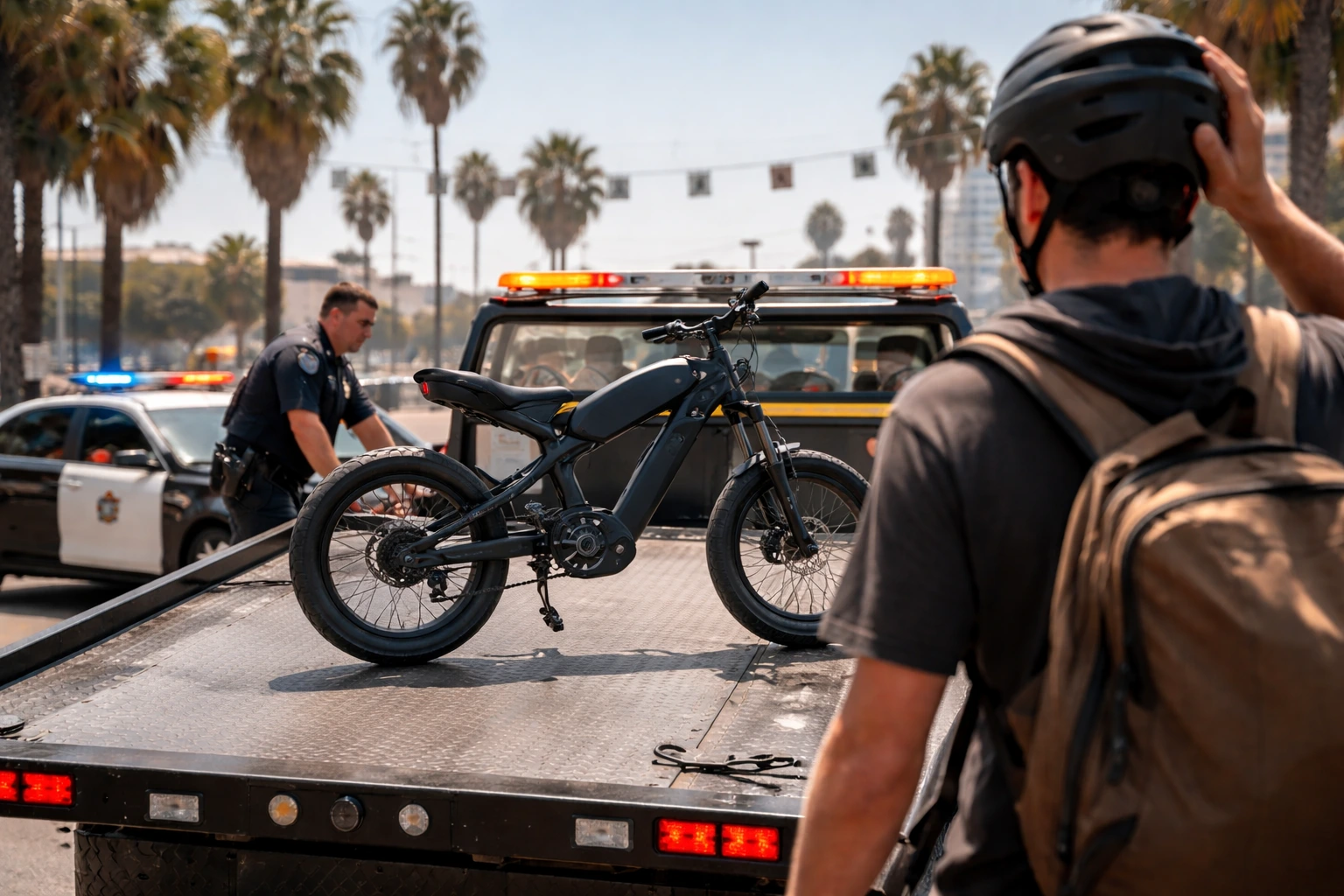
Thousands of e-bike riders in California may have unknowingly broken the law. If your electric bike has been modified to go faster than the legal limit, your ride could reportedly be impounded.
Riders across the United States are paying close attention because California often leads the way on e-bike regulation. This is not just about a fine. Reports suggest your bike could be taken, reclassified, and you could even face criminal charges.
What Is the New California E-Bike Speed Modification Law?
The new California e-bike speed modification law is reportedly AB 1774, signed in July 2024 and now working alongside stricter 2026 enforcement rules. It appears to make it illegal to tamper with or modify an e-bike so that it exceeds legal speed limits.
Reports suggest Class 1 and Class 2 e-bikes are capped at 20 mph, while Class 3 models are limited to 28 mph with pedal assist. The law reportedly also bans the sale of speed modification kits designed to override e-bike speed limiters. But breaking the speed cap is only the beginning of the problem for riders who modify their bikes.
What Happens if Your Modified E-Bike Gets Caught?
If your modified e-bike gets caught, reports suggest you could face citations, fines, and even criminal charges. Under AB 875, law enforcement may reportedly impound your bike for at least 48 hours.
Here is what riders could reportedly face:
- Citations and fines under California Vehicle Code
- Bike impoundment for a minimum of 48 hours
- Criminal charges for serious violations
But the consequences appear to go beyond just a ticket. A modified e-bike that no longer meets the legal definition could reportedly be reclassified entirely, and that changes everything about how you are allowed to ride it.
How Could a Speed Hack Get Your E-Bike Reclassified?
A speed hack could get your e-bike reclassified as a motor vehicle under California law. Reports indicate that if your bike exceeds the 750 watt power cap or surpasses its class speed limit after modification, it may no longer qualify as an electric bicycle.
Once reclassified, riders would reportedly need:
- DMV registration
- A valid driver's license
- Insurance coverage
Most riders who modify their e-bikes are reportedly unaware of this risk. That means they could be riding without registration or insurance, leading to additional penalties. But the law does not just target riders. It also goes after the people selling the modification kits.
Who Else Could Face Penalties Under This Law?
Sellers and retailers of e-bike speed modification devices could also reportedly face penalties under AB 1774. The law appears to ban the sale of any product designed to push an e-bike beyond its legal speed classification.
Reports suggest this targets online sellers, local shops, and aftermarket dealers offering items like derestriction kits, speed controller override chips, and software tools that remove limiters. Violations could reportedly result in criminal charges.
The goal appears to be shrinking the modification market itself, not just catching individual riders. And this speed crackdown is just one piece of a much larger e-bike enforcement push happening across California.
What Other E-Bike Laws Are Changing in California for 2026?
Several other e-bike laws are reportedly changing in California for 2026, and AB 1774 does not exist in isolation. Key changes include:
- SB 1271 — E-bike batteries sold in California must reportedly be safety certified by an accredited lab
- AB 544 — E-bikes must now reportedly display a rear red reflector or red light at all times
- AB 875 — Police may reportedly impound Class 3 e-bikes operated by riders under 16
- AB 1942 — A proposed bill that could require Class 2 and Class 3 e-bikes to carry DMV license plates
Together, these laws suggest California is building a much tighter regulatory framework for electric bikes. Riders on compliant e-bikes should reportedly not be affected. But those riding modified or non compliant bikes may want to pay close attention.
Frequently Asked Questions
Is it illegal to modify your e-bike speed in California?
Reports suggest that under AB 1774, tampering with an e-bike to exceed its class speed limit is illegal. Selling speed modification devices is also reportedly banned.
Can police impound your e-bike in California?
Reports indicate that under AB 875, law enforcement may impound non compliant or modified e-bikes for at least 48 hours.
What speed is legal for e-bikes in California?
Class 1 and Class 2 e-bikes are reportedly limited to 20 mph. Class 3 models are reportedly capped at 28 mph with pedal assist.
Can a modified e-bike be reclassified as a motor vehicle?
Yes. Reports indicate that if a modified e-bike exceeds the 750 watt power cap or its class speed limit, it may be reclassified as a motor vehicle requiring DMV registration, a license, and insurance.
Can you sell e-bike speed modification kits in California?
Reports suggest that AB 1774 bans the sale of any product designed to override an e-bike's speed limiter or push it beyond its legal class speed. Violations could result in criminal charges.